
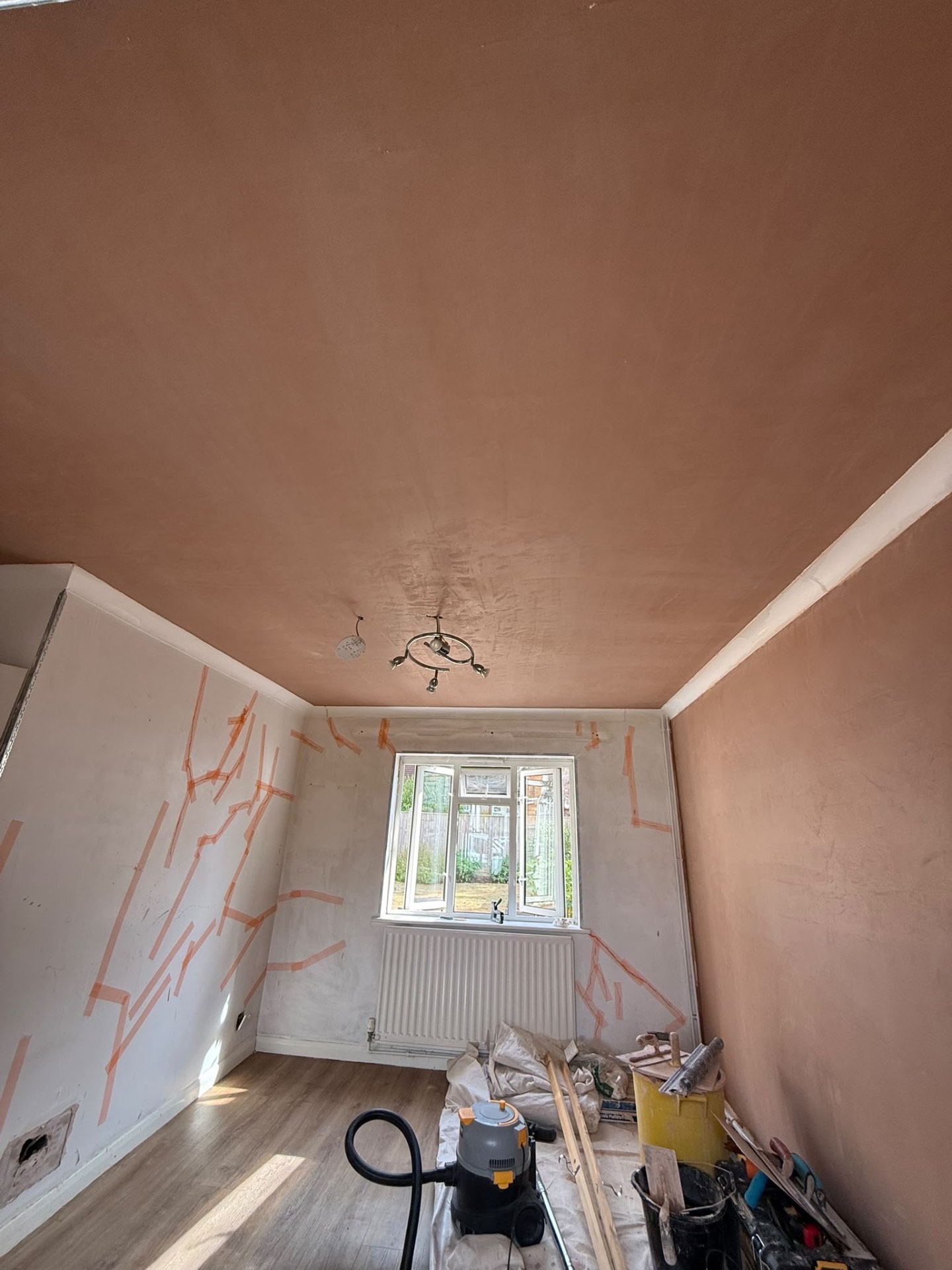
Where dry lining is used
Dry lining is used for new stud partitions dividing up a room or creating an extra bedroom, for lining solid masonry walls either directly or with insulation behind the board to improve thermal performance, for ceilings in extensions and loft conversions, and for refurbishment work where an existing wall is in poor condition and boarding over it is a practical alternative to extensive wet plaster repair.
It's also a common approach in loft conversions and extensions, where stud walls and ceilings are built from scratch and plasterboard forms the natural finish before skimming or jointing.
Dry lining methods and when each applies
There are a few common approaches: boarding fixed to timber or metal studwork for new partitions, board fixed directly to masonry with dot-and-dab adhesive for lining solid walls, and board screwed to joists or rafters for ceilings. Each method suits different situations, and the choice often depends on the condition of the existing wall, whether insulation needs to be incorporated, and the structural layout of the room.
Insulated plasterboard, which combines an insulation layer bonded to the board, is sometimes used on solid external walls to improve thermal performance, though its suitability depends on the wall construction and existing moisture conditions, which is worth assessing before specifying it.
Preparing a wall or ceiling for dry lining
Preparation depends on the method used. For dot-and-dab lining, the wall needs to be reasonably flat, clean, and free of damp before boards are bonded to it, since fixing insulated or standard board over a damp wall can trap moisture against the masonry rather than let it dissipate. For new stud partitions, the frame needs to be built square and plumb before boarding.
Where an existing wall shows signs of damp, whether rising, penetrating, or condensation-related, that cause should be identified and addressed before dry lining goes ahead, since boarding over an active damp problem conceals it rather than resolving it, and can make the underlying issue harder to detect until it's more advanced.
What to expect during installation
Once a wall or ceiling is boarded, the joints between boards are typically taped and filled, and the whole surface is often given a skim coat to achieve a smooth, continuous finish ready for decoration, though a taped-and-jointed finish without a full skim is sometimes used depending on the specification. Fixing boards generally takes less time than a full wet plaster application, but the finishing stage (jointing or skimming) still needs proper drying time between coats.
For stud partitions, the process also involves building the frame itself, which may include considerations for electrical cabling, sound insulation, or door openings depending on the room's use.
Dry lining considerations for Aldershot properties
In newer developments around Aldershot, dry lining on timber or steel stud is the standard method of construction for internal walls, making repairs and alterations relatively straightforward. In older properties, dry lining is more often used as a renovation option for solid masonry walls that are in poor condition or where additional insulation is wanted, though on period properties with solid walls, the implications for the wall's ability to manage moisture should be considered before boarding over it.
Loft conversions and extensions across the town frequently use dry lining for new ceilings and partitions, generally finished with a skim coat to match the rest of the property.
Getting a quotation
Dry lining quotations take into account the area to be lined, whether new studwork is needed, the condition of the existing wall where boards will be fixed directly, and the finish specified (taped and jointed, or fully skimmed).
To discuss a dry lining job in Aldershot or nearby, call PlastererAldershot on 07881 365851.